

Starting occupational therapy can feel like stepping into the unknown. Maybe your doctor recommended it after surgery. Maybe a loved one suggested it after noticing daily tasks becoming harder. Or maybe you simply want to regain independence after a health setback.
Whatever brought you here, one thing is true: the more you understand before starting occupational therapy, the more confident and successful your experience will be.
Many patients begin therapy without asking questions, only to realize later they were unsure about the process, expectations, or goals. Learning the right questions to ask occupational therapist before your first session can help you feel more prepared and confident about what lies ahead. Asking the right questions helps you:
- Feel more prepared
- Understand how therapy helps
- Know what progress looks like
- Set realistic expectations
- Become an active partner in your recovery
12 Questions to Ask Occupational Therapist Before Starting Therapy
Here are 12 important questions you should ask before starting occupational therapy so you can make the most of your care.
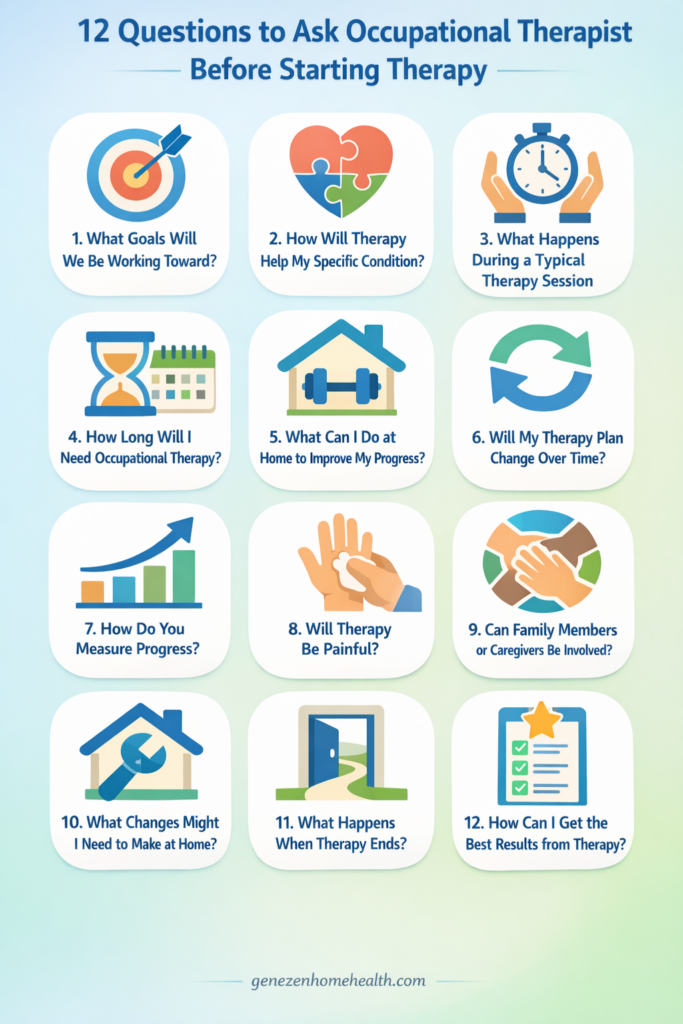
1. What Goals Will We Be Working Toward?
Occupational therapy is not just about exercises. It is about helping you do the things that matter in your daily life.
This could include:
- Getting dressed independently
- Cooking safely
- Bathing without assistance
- Returning to work tasks
- Improving memory or focus
- Preventing falls with OT
A good therapist will ask about your personal goals, not just your medical condition.
You might ask:
- What can I realistically improve?
- How will we measure progress?
- How long might it take?
When therapy connects to real-life goals, motivation becomes much easier.
2. How Will Therapy Help My Specific Condition?
Not all therapy plans look the same. What works for one patient may not work for another.
Ask how therapy connects to your situation:
For example:
- Stroke patients may work on coordination and independence
- Surgery patients may focus on mobility and safe movement
- Seniors may focus on fall prevention
- Patients with chronic illness may work on energy conservation
Understanding the why behind therapy makes it easier to stay committed.
You might ask:
- What improvements do patients like me usually see?
- What challenges should I expect?
This helps you set realistic expectations instead of hoping for instant results.
3. What Happens During a Typical Therapy Session?
One of the most important questions to ask occupational therapist before starting therapy is what a normal session actually looks like. Many patients worry therapy will be painful, uncomfortable, or too physically demanding. In reality, occupational therapy is usually very practical, supportive, and adjusted to your comfort level and abilities.
Sessions often include:
- Gentle exercises
- Practicing daily activities
- Learning safer movement techniques
- Home safety education
- Using adaptive tools
- Building strength gradually
Therapy should feel challenging but not overwhelming.
You can ask:
- Will sessions be physically demanding?
- What should I wear?
- Do I need equipment?
Knowing what to expect removes a lot of unnecessary fear.
4. How Long Will I Need Occupational Therapy?
Among the most practical questions to ask occupational therapist is how long therapy might last, because most patients want to know how much time they should expect to commit to recovery. This is one of the most common questions patients have.
The honest answer is: it depends.
It depends on:
- Your condition
- Your starting ability
- Your consistency
- Your goals
- Your health progress
Some patients need a few weeks. Others benefit from several months.
Instead of asking only about time, you might ask:
- What signs show I am improving?
- When do patients usually see progress?
- What happens if progress is slow?
Recovery is rarely a straight line. Knowing this ahead of time prevents discouragement.
5. What Can I Do at Home to Improve My Progress? (Most Patients Forget This)
This might be the most important question on this list.
Therapy sessions may only happen a few times per week. But recovery happens every day.
Patients who improve the fastest usually:
- Follow home exercises
- Apply safety techniques
- Practice daily skills
- Stay consistent
Therapists often provide simple home strategies like:
- Safe ways to stand up
- Energy-saving techniques
- Hand exercises
- Balance activities
- Memory strategies
Ask:
- What should I practice between visits?
- What habits will help recovery?
- What should I avoid?
This question turns you from a passive patient into an active participant.
And that often makes the biggest difference.
6. Will My Therapy Plan Change Over Time?
A key consideration to bring up is included in the questions to ask occupational therapist before starting therapy: how often your plan will be adjusted. Good therapy is not static. As you improve, your therapy should evolve to match your progress and changing needs.
Your therapist may:
- Increase difficulty gradually
- Introduce new activities
- Shift focus to independence
- Reduce assistance
- Focus on long-term prevention
Ask:
- How often will my progress be evaluated?
- Will goals change as I improve?
Therapy should grow with you.

7. How Do You Measure Progress?
One of the most useful questions to ask occupational therapist is how they track and measure your progress, so you know what improvements to expect. Progress is not always dramatic. Sometimes it shows up in small victories like:
- Standing longer
- Less pain during tasks
- Better balance
- Improved coordination
- Increased confidence
- Less need for help
Therapists may track:
- Strength improvements
- Functional abilities
- Safety improvements
- Task completion
- Independence levels
Ask:
- How will we know therapy is working?
- What improvements should I notice first?
Knowing what progress looks like helps you stay encouraged.
8. Will Therapy Be Painful?
This is a very honest concern.
Most occupational therapy is not about pushing through pain, but about improving function safely.
Some discomfort may happen when:
- Building weak muscles
- Improving mobility
- Practicing new movements
But therapy should not feel unsafe or overwhelming.
Ask:
- What discomfort is normal?
- When should I speak up?
Good therapists want feedback. Your comfort matters.
9. Can Family Members or Caregivers Be Involved?
A helpful topic to bring up is part of the questions to ask occupational therapist before starting therapy: whether family members or caregivers can participate. Occupational therapy often works best when those supporting the patient understand how to help safely.
Family members may learn:
- Safe transfer techniques
- How to assist without causing injury
- How to encourage independence
- Home safety adjustments
- Communication strategies
Ask:
- Can my caregiver join sessions?
- Will you teach them how to help me safely?
When caregivers are educated, recovery often becomes smoother and safer.
10. What Changes Might I Need to Make at Home?
Sometimes recovery is not just about the patient — it is also about the environment.
Small changes can make a big difference.
Examples include:
- Removing trip hazards
- Installing grab bars
- Improving lighting
- Using shower chairs
- Rearranging frequently used items
- Using adaptive tools
Ask:
- Are there safety risks at home?
- What simple changes help most?
Many injuries happen at home. Prevention is a big part of occupational therapy.
11. What Happens When Therapy Ends?
One important topic to discuss is included in the questions to ask occupational therapist before starting therapy: what support and guidance you’ll receive once sessions are over. Many patients worry progress will stop once therapy ends, but good therapy prepares you for independence.
You may receive:
- Home exercise plans
- Safety routines
- Prevention strategies
- Maintenance activities
- Warning signs to watch
Ask:
- How do I maintain progress?
- What should I continue doing?
- When should I seek help again?
Therapy is not just about short-term improvement. It is about long-term success.
12. How Can I Get the Best Results from Therapy?
One of the most impactful questions to ask occupational therapist before starting therapy is how you can maximize your results. This shows commitment and helps you take an active role in your recovery.
Most therapists will say results improve when patients:
- Stay consistent
- Communicate openly
- Practice at home
- Stay patient
- Celebrate small wins
- Ask questions
You can ask:
- What do successful patients do differently?
- What mistakes should I avoid?
Recovery is a partnership, not something done to you.
It is something done with you.
Why Asking These Questions Matters More Than You Think
Starting occupational therapy is not just about scheduling visits. It is about choosing to invest in your independence, safety, and quality of life.
When patients ask questions:
- They feel less anxious
- They stay more motivated
- They understand their progress
- They participate more actively
- They often recover better
Knowledge removes fear. And confidence often improves outcomes.
You deserve to understand your care.
When Should You Consider Occupational Therapy?
Many people wait too long because they think their struggles are “normal.”
You might benefit if:
- Daily tasks feel harder than before
- You feel less steady walking
- You avoid activities you used to do
- Recovery feels slow after illness
- You rely more on others
- You feel less confident moving around
Occupational therapy is not only for severe conditions. It is often most helpful when started early.
Sometimes small improvements create big life changes.
The Real Goal of Occupational Therapy

At its heart, occupational therapy is not about exercises.
It is about helping people:
- Live safely
- Stay independent
- Feel confident
- Do meaningful activities
- Maintain dignity
- Adapt to life changes
It focuses on what people can do, not just what they lost.
And sometimes the biggest improvement is not physical strength — it is confidence returning.
Final Thoughts: The Best Question You Can Ask Might Simply Be “Can This Help Me?”
If daily life has started to feel harder than it should, asking questions is not a sign of weakness. It is often the first step toward getting your life back on track. Occupational therapy is not just for recovery — it is for rebuilding confidence, restoring independence, and making everyday life feel manageable again. Sometimes the smallest improvements create the biggest difference in how you live each day.
If you or a loved one is considering occupational therapy at home, Genezen Home Health Care Services provides compassionate therapists who help patients rebuild independence in the place they feel most comfortable — their own home. If you want to learn how occupational therapy could support your recovery or daily living, reaching out could be the first step toward making life easier, safer, and more independent again.